Bioclimatology and Bioclimatic Design of Urban Open Space
Content
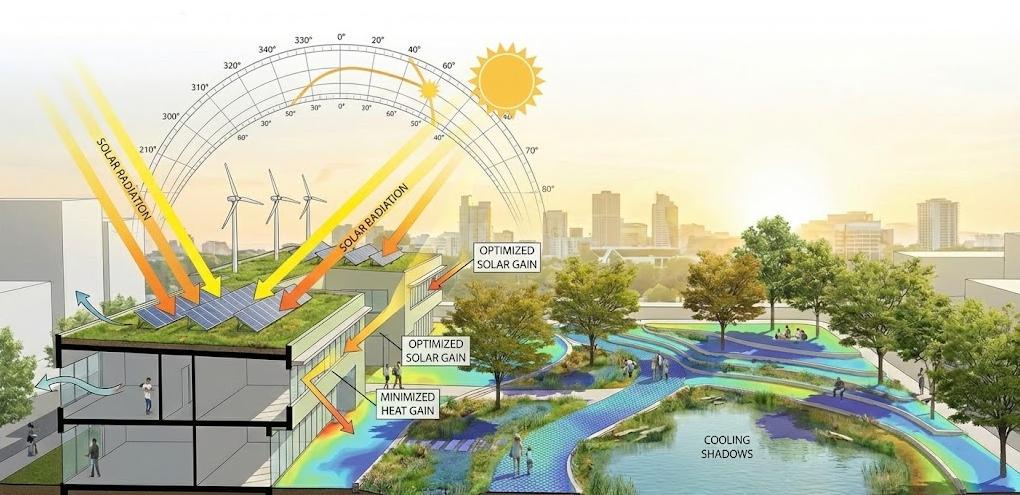
Introduction to bioclimatology and bioclimatic design of urban open spaces. Presents urban microclimate and bioclimate. The urban canopy layer climate. The urban energy balance. Urban heat island and urban cool island. Thermal comfort and sensation. Principles and theory of bioclimatic design. Bioclimatic design as a function of macro-, meso-, and micro- climate and its applications in dry-warm/hot climates with emphasis in the Mediterranean region. Microclimatic conditions and bioclimatic design of urban open spaces. Field monitoring and estimations using advanced techniques. Case studies. Microclimate and bioclimatic design strategies of urban open spaces and urban heat island mitigation strategies. Vegetation, Shading, Evaporative Cooling, Ventilation, Materials and colours, etc. Urban microclimate and bioclimate modelling. Principles of environmental modeling – Environmental models. Analytical, semi-analytical, numerical models, computational fluid mechanics (CFD) models. Software tools and applications in bioclimatic design and evaluation of bioclimatic scenarios. Analysis, evaluation and use of bioclimatic parameters of urban open spaces in urban planning design and in regeneration studies of urban infrastructure (urban complexes).
The Faculty of Crop Science of the Agricultural University of Athens (AUA), was founded in June 1989 (Official Journal of the Hellenic Republic Νο. 166Α΄/16-6-1989) it is the first University Faculty of Crop Science founded in Greece